
Here’s what you need in order to send money from Korea to the USA — the recipient details, how fees and exchange rates are applied, the limits that apply to foreign residents, and how long the money actually takes to land.
Key points
- ✅ You need an ACH routing number (9 digits). A wire routing number won’t work, and the two are often different at the same bank
- ✅ The destination has to be a US domestic checking or savings account held in USD — brokerage and foreign-currency accounts can’t receive the transfer
- ✅ If you’re a foreign resident in Korea, the guideline is USD 5,000 per transfer and USD 50,000 per calendar year
- ✅ The fee and the exchange rate that will apply are both shown before you confirm, so you never have to guess
Living in Korea while keeping a US bank account open means this comes up more often than you’d expect — rent or a mortgage back home, student loan payments, helping out family, or just moving savings across before the exchange rate moves again.
The first transfer is the awkward one. American bank details don’t line up neatly with the fields a Korean remittance app asks for, and one wrong number means the money bounces back days later. The questions below are the ones that come up most, answered in the order you’ll actually hit them.
1. What recipient details do I need to send money from Korea to the USA?
Five things: the recipient’s name as it appears on the account, the account type, a 9-digit ACH routing number, the account number, and a US address with a ZIP code. Get those right and the rest is form-filling.
Sending to an individual
| Field | What to enter |
|---|---|
| Recipient name | English name as printed on the account — surname, first name, middle name (middle name optional) |
| Account type | SAVING or CHECKING |
| Routing number | ACH routing number, 9 digits — the “paper & electronic” one. A wire routing number can’t be used |
| Account number | Up to 17 digits. US domestic accounts only, held in USD |
| Recipient contact | Email address, plus a street address including the ZIP code |
Sending to a business
| Field | What to enter |
|---|---|
| Company name | Registered business name on the account |
| Account type | SAVING or CHECKING |
| Routing number | ACH routing number, 9 digits (wire not accepted) |
| Account number | Up to 17 digits, US domestic USD account |
| Business address | Street address including the ZIP code |
Where to find the ACH routing number. On a paper check, it’s the leftmost 9-digit block along the bottom — that one is normally the ACH number rather than the wire number. In online banking, look under “account details” or “direct deposit information.” If your bank lists two routing numbers, use the one labelled for ACH, electronic, or direct deposit. Some banks also assign ACH routing numbers by the state where the account was opened — not where the account holder lives now — so read it off the account itself rather than from a general list.
2. Which US accounts can receive the transfer?
Checking and savings accounts held at a US bank, in USD. That’s the full list.
Which means a few common destinations don’t work:
- Wire-only routing numbers. The transfer runs on ACH, so a wire routing number will be rejected even though it belongs to the right bank.
- Brokerage and investment accounts. Even ones that look and behave like a checking account.
- Foreign-currency accounts. The receiving account has to hold USD.
- Accounts outside the US. A US bank’s overseas branch isn’t a US domestic account.
Beyond that, the bank itself matters less than the details do — what has to be right is the name, the routing number, and the account number, exactly as they appear on the account.
3. How much does it cost?
The fee depends on how much you’re sending, and it’s shown on screen before you commit. Enter the amount in the app or on the web, and you’ll see the fee and the exchange rate that will be applied to that specific transfer.
The rate refreshes roughly every 10 minutes and locks in at the moment your application is completed — so the number you agreed to is the number you get, even if the market moves while the transfer is being processed.
4. How long does it take?
Plan on one to two business days from end to end. The breakdown:
| Stage | Typical time |
|---|---|
| Document review | About 2 hours (longer at peak times) |
| Transfer processing | Average 1 business day, up to 2 business days |
| Credit to the recipient’s account | Depends on the receiving bank’s own posting schedule |
Two things to build into your timing: ACH settles in batches rather than instantly, and US banks don’t process on weekends or federal holidays. Anything sent late on a Friday waits for the next business day before it moves.
Because MOIN sends directly without routing through intermediary banks, there are fewer hand-offs along the way. Arrival time still depends on the receiving bank, and delays outside anyone’s control do happen — so if the money has a deadline attached, send it with a few days to spare.
5. How can I check that the transfer went through?
You’ll get a notification when the transfer completes, and you can track the status any time from the app or the web.
Worth knowing: “completed” on your side means the money has left and been sent on. The recipient sees it once their own bank posts it, which can be a little later. If it matters, ask them to confirm it landed rather than assuming.
6. Do the sender and the account holder have to be the same person?
Yes. The transfer has to be made in your own name — the person applying is the person sending.
That means your ID documents, your contact details, and the Korean bank account you pay in from all have to belong to you. You can’t send on behalf of a spouse, a friend, or an employer using their money and your account. This isn’t a MOIN policy — it’s how Korea’s foreign exchange rules treat remittance, so it’s worth checking before you apply.
7. How much can I send from Korea to the USA?
Most foreign residents in Korea fall under the “foreigner” category. The guideline figures:
| Category | Annual cumulative limit | Per-transfer limit |
|---|---|---|
| Foreign residents | USD 50,000 | USD 5,000 |
| Korean nationals (for reference) | USD 100,000 | USD 100,000 |
A few things that catch people out:
- The annual count runs January 1 to December 31. It doesn’t reset on your visa date or your arrival date, and it doesn’t roll over.
- The per-transfer limit is set by destination country. USD 5,000 applies to the US and to most destinations; China is the exception at KRW 5.5 million.
- The same limits apply whether you’re sending as an individual or as a company.
Larger amounts are possible where there’s documentation behind the payment. A transfer backed by an invoice or a contract — a business payment rather than a personal one — falls under documented remittance, which is handled separately and allows higher amounts.
(Source: MOIN BizPlus)
8. How is this different from sending an international wire through my bank?
A bank wire travels over SWIFT, which usually means passing through one or more intermediary banks between Korea and the US. Each institution in that chain can take a cut — a cable fee on the Korean side, an intermediary bank fee in the middle, a receiving fee at the other end. You often don’t find out the total until the recipient tells you what actually arrived.
MOIN sends directly, without intermediary banks in the path, so those layered charges don’t stack up the same way. What it costs on any given transfer depends on the amount, and you’ll see the figure before you confirm.
9. What should I check before paying into the deposit account?
After you apply, you transfer the won into a dedicated deposit (virtual) account. This step has the most rules attached, and getting it wrong is what usually stalls a transfer.
- Pay from the Korean bank account you registered, using that bank’s mobile, internet, or telephone banking. Simple-payment services such as Toss Pay, Kakao Pay, and PAYCO can’t be used — those payments are automatically returned in full.
- Send from the account you verified with MOIN. You can change the verified account, but only during operating hours.
- Some accounts aren’t eligible: legacy account numbers from before a bank merger, and “lifetime account” services. IBK sole-proprietor accounts may not work either.
- Transfer the exact amount shown, down to the last won, within one hour.
- Bank counter and ATM deposits aren’t accepted.
- Check your own account’s daily and per-transaction transfer caps first. Korean banks apply their own limits, and a large remittance can quietly exceed them.
If any one of these doesn’t match, the payment won’t complete.
10. Do I need to report the transfer to the IRS?
Moving your own money into your own US account isn’t income and isn’t a gift, so routine transfers of salary or savings generally don’t create a new filing obligation on their own. Two separate US rules are worth knowing about, though, because they catch people who never thought of themselves as having a tax question.
If someone else’s money is arriving. A US person who receives more than USD 100,000 in a year in gifts or bequests from a nonresident alien or foreign estate reports it on Form 3520. Gifts from a foreign corporation or partnership have a much lower threshold, and the IRS adjusts it every year — check the current figure if that applies to you.
(Source: IRS — Gifts from foreign person)
If you hold Korean accounts. A US person whose foreign financial accounts total more than USD 10,000 at any point in the year files an FBAR (FinCEN Form 114). It’s the combined peak balance across all accounts, not per account — and a Korean salary account plus a savings account can clear it easily.
(Source: IRS — Report of Foreign Bank and Financial Accounts (FBAR))
Both are reporting requirements, not taxes — filing doesn’t mean you owe anything. But the penalties for missing them are steep, and how they apply depends on your own residency and filing status, so treat the above as a prompt to check rather than an answer. For anything sizeable, talk to a cross-border tax professional before you send.
11. Sending Money Abroad from Korea | MOIN International Transfers
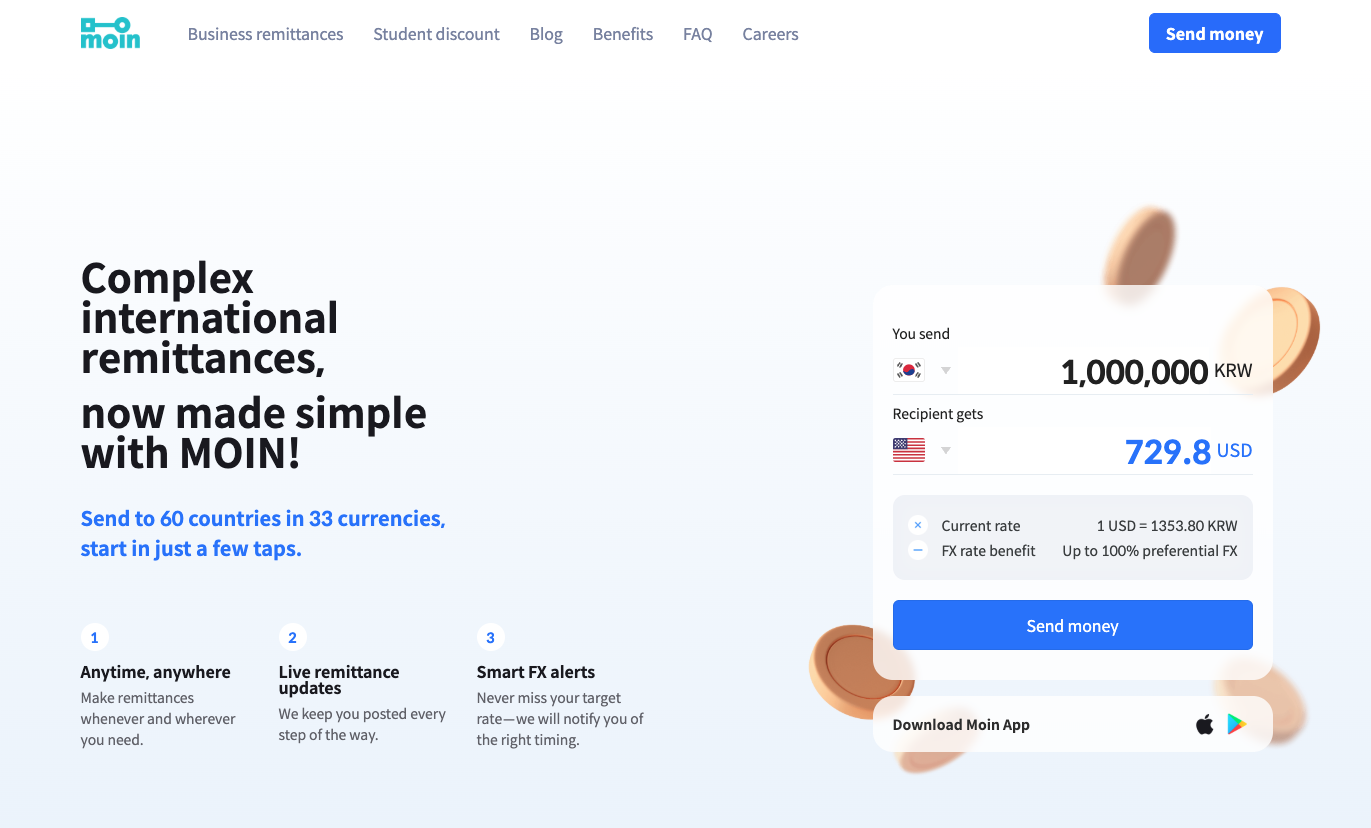
Bank fees adding up, but the alternatives feel like a gamble? That’s the gap MOIN is built for.
Why people choose MOIN
- ✅ Your recipient doesn’t sign up for anything — the money lands in their bank account
- ✅ One app, whenever and wherever you need to send
- ✅ Direct transfers with no intermediary bank in the path
- ✅ Compared with a bank’s international transfer fees, you can keep the cost down
- ✅ A lighter load from exchange and fees, so more of what you send arrives
MOIN is a licensed international money transfer service registered with Korea’s Ministry of Economy and Finance. You can send from Korea to the United States and to countries around the world.
12. Blog-Only Coupon 🎁
A small thank-you for reading. Here’s a coupon that takes the fee down on your next international transfer — the US, and everywhere else MOIN sends.

<Blog-only coupon>
- Coupon code: MOINEN
- Discount: KRW 3,000 off the transfer fee
- Eligible destinations: all supported countries
- Valid: 15 days from the date you claim it
Get Started with MOIN
MOIN makes international transfers simpler than a bank, and keeps the cost down. Transfers go direct, without intermediary banks, so there’s no cable fee and no intermediary or receiving bank fee to absorb. You can check the estimated arrival time for your transfer in the app.